
In a Madrid rheumatology clinic last year, a man in his late thirties walked in with a story he had told several times already. Lower back pain, on and off, since his early twenties. Stiffness in the mornings that loosened up after he moved. Years of physiotherapy, ibuprofen, gym programmes. A few MRIs over the decade. Two orthopaedic referrals. One sports medicine consultation. By the time someone finally ordered an HLA-B27 test and a sacroiliac MRI with the right protocol, he had been living with undiagnosed ankylosing spondylitis for closer to a decade than to a year.
His case is not unusual. Recent European data places the average diagnostic delay for ankylosing spondylitis at roughly seven years. Lupus sits at around six. Sjögren's syndrome at four and a half. At the other end of the spectrum, rheumatoid arthritis and multiple sclerosis are now typically diagnosed within eighteen months. The gap between best-case and worst-case is enormous — and the worst-case is still measured in years, not weeks.
What follows is an examination of why that gap exists, why it is so unequal across autoimmune conditions, and what would have to change for the next decade to look different. The answer, ultimately, is not more clinicians, not more guidelines, not more awareness campaigns — though all of those help at the margin. The answer is infrastructure that does not yet exist.
The shape of the delay
To understand the diagnostic delay, it helps to see it. The figure below shows the average time from first symptoms to confirmed diagnosis across seven of the most common autoimmune conditions in Europe, drawn from a pooled analysis of cohort studies and registry data published between 2018 and 2024.
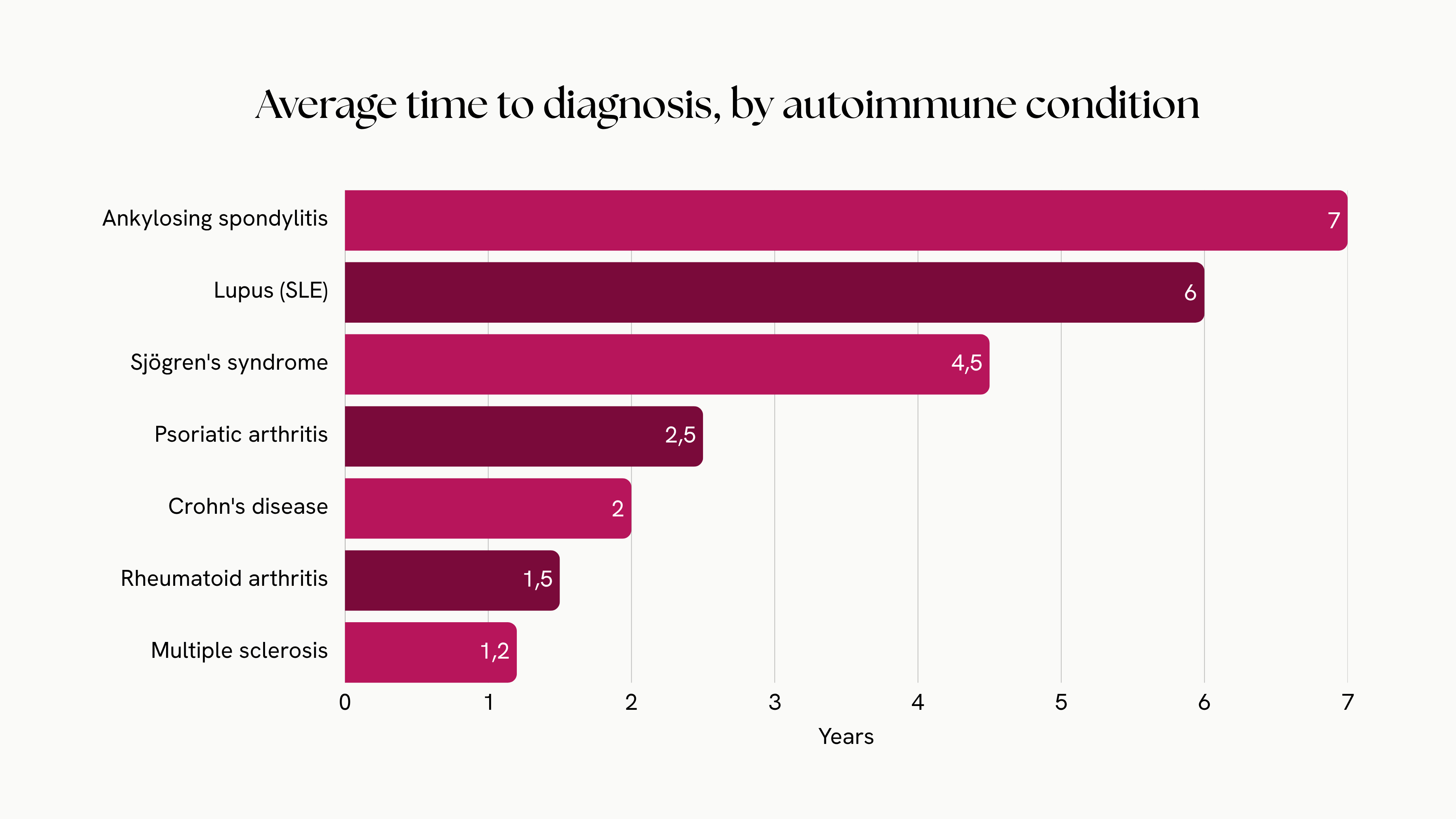
The first thing to notice is that the chart sorts itself, more or less, by a single variable: how identifiable the disease is in its early stages by routine clinical means. Multiple sclerosis presents with discrete neurological events that bring patients quickly to a specialist who orders an MRI. Rheumatoid arthritis presents with symmetrical joint inflammation and elevated inflammatory markers in blood tests that primary care physicians can read. Ankylosing spondylitis, at the other end, presents with back pain — the single most common reason for primary care consultations in Europe — that is initially indistinguishable from mechanical back pain.
The diseases at the top of the chart are not "worse" diseases. They are diseases whose early symptoms do not yet have an obvious clinical signature that gets the patient into the right specialist's chair fast enough.
Three structural causes
Beyond the clinical signature problem, three structural factors shape how long a patient waits. None of them are about individual clinicians making poor decisions. All of them are about the system around those clinicians.
The first is referral fragmentation. An autoimmune disease often manifests across body systems before it is recognised as autoimmune. A patient with early lupus might see a dermatologist for a rash, a rheumatologist for joint pain, a nephrologist for protein in their urine, a haematologist for a low platelet count — each of whom sees one organ system in isolation, treats it well within their specialty, and discharges the patient without anyone connecting the four observations into a single diagnosis. The patient walks between four buildings and four notes systems, carrying the connection in their own head, and the connection is the diagnosis.
The second is the absence of a longitudinal patient record that crosses specialties. Most European health systems have excellent within-specialty records and serviceable primary care records, but the autoimmune patient lives in the spaces between them. The data structure that would surface the lupus pattern — "this is the same patient seen across four specialties over eighteen months, here are her symptoms in aggregate" — does not exist in routine care. It exists, sporadically, in well-resourced research cohorts, but those cover a tiny fraction of patients.
The third is the patient's voice being absent from the record entirely. Between specialist visits, a patient with early autoimmune disease accumulates the most informative data anyone could collect about her condition — symptom patterns, triggers, flare frequency, response to treatment. None of it enters the medical record. By the time she sees a specialist, she is asked to compress months of lived experience into a fifteen-minute consultation, from memory, often translating into clinical language that does not feel like her own.
The diagnostic gap is not a story about medicine failing. It is a story about a data layer that does not yet exist.
Why awareness campaigns do not close the gap
The instinct, when faced with a delay of this size, is to push for more awareness. More training for primary care. Earlier referral protocols. National "think autoimmune" campaigns. These efforts have produced modest improvements over the past decade — average delays have been falling, slowly, in most European countries — but they are running into a ceiling.
The ceiling exists because the bottleneck is not what individual clinicians know. The bottleneck is what individual clinicians see. A primary care physician faced with a patient presenting back pain has no way of knowing, in that moment, whether the patient has been to two other doctors with related symptoms over the past three years. The information needed to make the right referral exists, but it is scattered across systems that do not speak to each other. Awareness without infrastructure produces frustration, not diagnoses.
What would have to change
If we accept that the diagnostic gap is fundamentally an infrastructure problem, three things have to be true to close it:
- A longitudinal record that travels with the patient across specialties, built on interoperable European standards (FHIR for clinical data, OMOP for research data) rather than a hundred parallel hospital systems.
- The patient's own observations as a first-class data source, structured well enough to be clinically interpretable and integrated into the specialist's view rather than discarded at the door.
- A regulatory frame that allows this kind of integration to happen lawfully across borders, with consent, proportionality, and patient agency as defaults rather than friction points.
The first two are product problems. The third is a regulatory problem that Europe is already solving, slowly, through the European Health Data Space — the secondary-use framework that comes into force in 2029. The product problems are what Neural Omega exists to address. We talk about Maia Clinical and Maia as separate products because they serve different audiences, but they are two faces of the same data layer. The clinician sees the patient she has in front of her, in context. The patient sees her own history, in her own language. Both write to the same record, with the same standards, under the same European compliance.
None of this fixes the diagnostic gap on its own. The medicine still has to be practised. The clinical reasoning still has to happen. The relationship between patient and specialist still has to be the thing that produces the diagnosis. But the infrastructure beneath it can decide whether the average autoimmune patient walks into that specialist's office in year one of her disease or year seven.
That is the work.